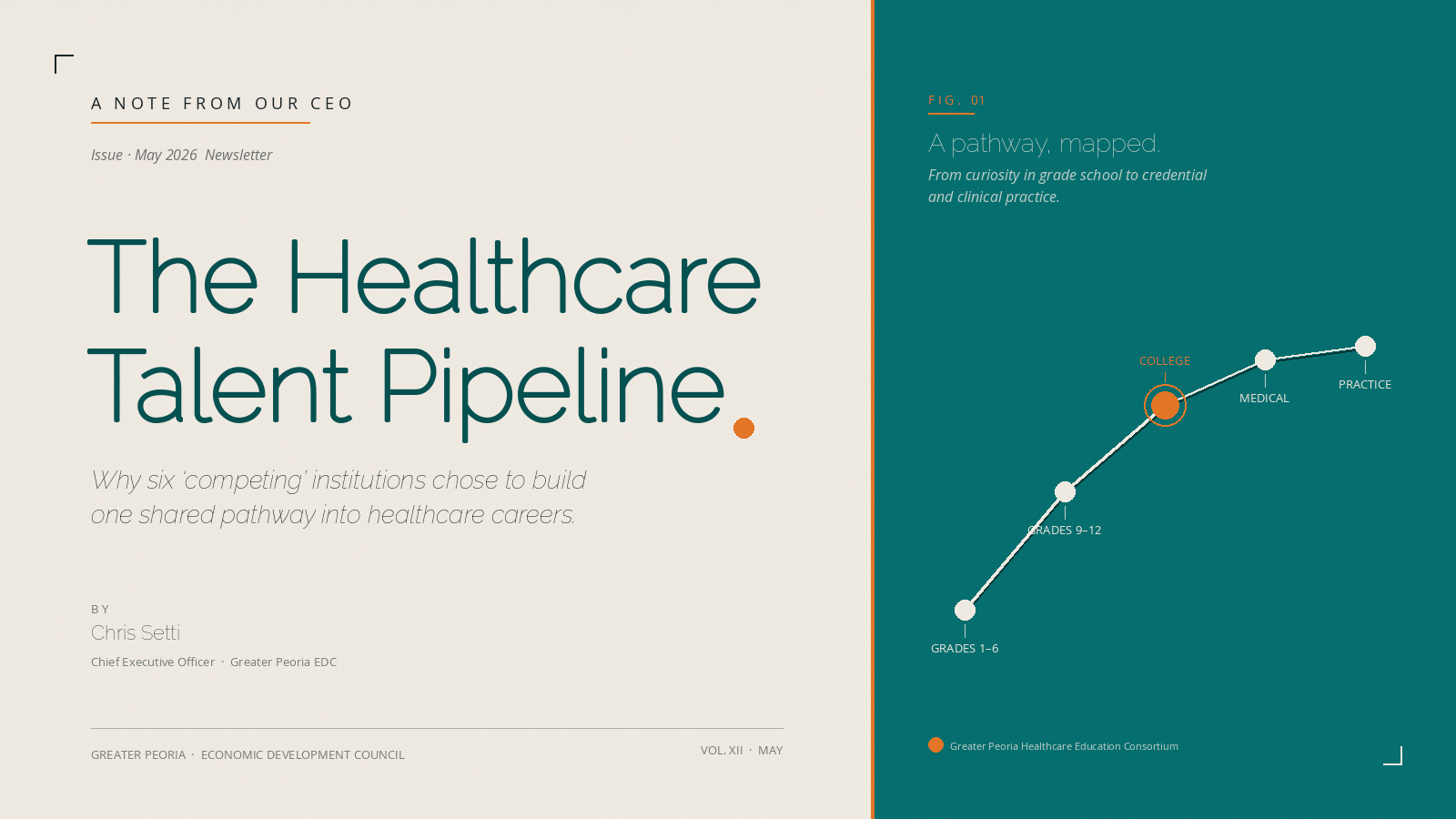
One of the top stories in this month’s newsletter is the announcement of the Greater Peoria Healthcare Education Consortium. On the surface, this might seem like a pretty straightforward idea, but in fact it is really pretty complex. The Consortium – which has been working together for a few years to develop a strategic framework and plan – belies the notion that “competitors” cannot work well together for a common purpose that elevates them individually and collectively. And given the amazing role that healthcare plays in the Greater Peoria economy, the timing could not have been better.
The Consortium currently has seven members:
- Methodist College (a part of the Carle Health family)
- OSF St. Francis College of Nursing
- Bradley University
- Illinois Central College
- University of Illinois College of Medicine Peoria
- Peoria Public Schools
- East Peoria Community High School (starting Fall 2026)
The first four institutions in that list all train nurses (among other careers) to one extent or another. You would think that if they are fighting each other over the pool of potential enrollees, there would be little room for cooperation. But you would be wrong. They are believers in the old adage that “a rising tide lifts all boats.” The goal of the Consortium is to broaden the pool of people (and specifically youth) interested in health careers. When they succeed in that, there will be more applicants to choose from.
Why do they care about growing the pie? Well, healthcare has become the dominant player when it comes to jobs. In 2025, data shows that just over 32,000 jobs were categorized as “Health Care and Social Assistance.” That represented 18.7% of all jobs in the region, beating out manufacturing (about 23,000 jobs, 13.3%). Nearly 20% of the jobs were registered nurses, but there were also plenty of people working as nursing assistants, home health care professionals, medical assistants, and, of course, physicians.
But that is just the present state of affairs. There are causes for both concern and celebration in the future, but both require a more concerted effort to train people to take healthcare related jobs. A 2024 study predicted a shortfall of 15,000 registered nurses in Illinois by 2025 (last year!) Another study projected that Illinois would be short 6,200 physicians by 2030. If I kept looking, I’m sure I could find evidence of dire projections in nearly every medical occupation.
Those are the numbers if we do nothing. But our region is not standing still – our healthcare industry is growing, which makes the issue even more important. Something special is happening in Greater Peoria when it comes to healthcare. OSF Healthcare is the region’s largest employer and continues to invest in its facilities to make Peoria a destination for medical services. Its Cancer Therapy Center is the most obvious example of this future, but it continues to grow its care across all disciplines. We also see investments by Carle Health in Pekin and Peoria, a planned expansion at the University of Illinois College of Medicine Peoria, the growth of Springfield Clinic’s presence here, and other evidence that our healthcare industry is hitting another gear.
All of this is proof that this Consortium is engaging in important work. Their primary aim is to get today’s students to understand that there is a future in healthcare tomorrow. To reverse the predicted shortages AND to keep up with our projected growth, we need to expand the pool of interest and point that interest to certificates, credentials, and degrees that lead to jobs. The GPEDC team is excited to work with the Consortium to help bring this collaboration to fruition.