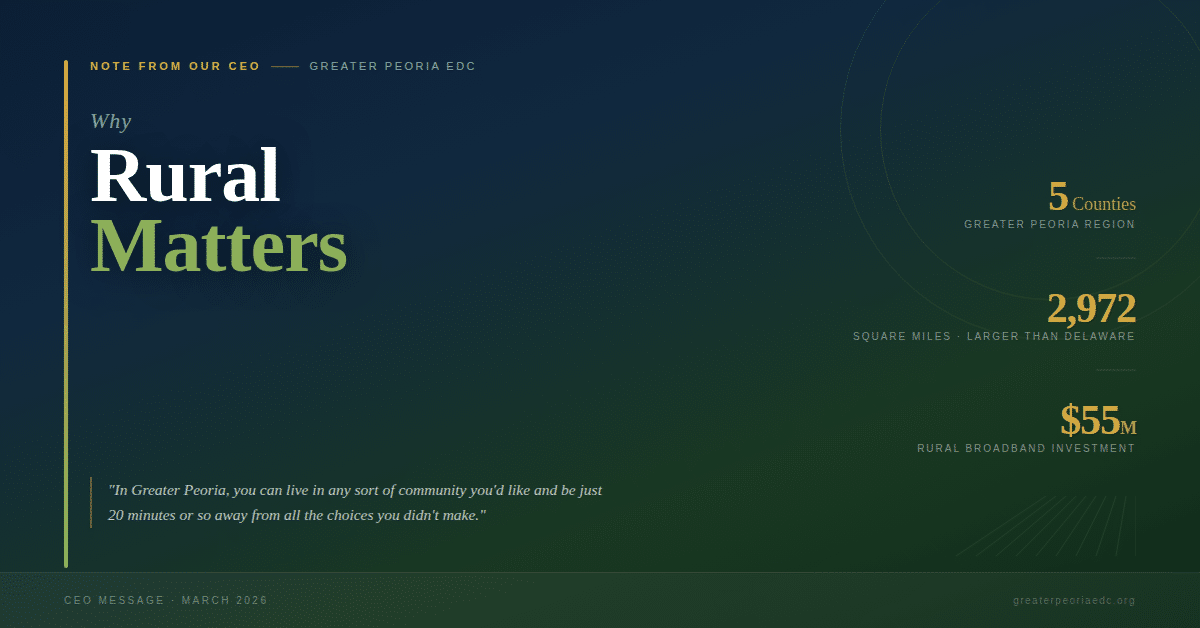
How many times have you heard this about Peoria: “Big city amenities in a small town.” That is certainly true in many respects, but the truth is that Greater Peoria is a big place. If you combine our five counties, they total 2,972 square miles. Geographically, that’s bigger than the entire state of Delaware. The region’s population is estimated at just under 390,000, but nearly 170,000 live outside the “city parts.” Sometimes the work of our organization might seem very focused on the more urban parts of Peoria and Tazewell counties, but our mission is to serve all of our region. Rural Greater Peoria is an incredibly important ingredient in our region’s future. In fact, it’s an ingredient we can leverage to drive economic growth.
One of the pitches I make when talking about our region is this: In Greater Peoria, you can live in any sort of community you’d like and be just 20 minutes or so away from all the choices you didn’t make. But the key to that statement is the proximity of our urban and suburban areas to rural Greater Peoria. As a kid growing up in suburban Los Angeles, I never valued or understood this. Burbank was flanked on all sides by other suburbs. The closest commercial farm was likely 45 miles away. Moving to Peoria helped me understand the powerful mix of city and country and how each benefits from the other.
So why should any “city dweller” reading this care about rural economic development? First, they are our neighbors and fellow citizens. They are patrons at city restaurants, shoppers at city retail outlets, and guests at city events. Just as importantly, many rural residents come into the urban area every day for work. That is why Illini Bluffs and Tremont schools need to be just as successful as Peoria Public Schools and Pekin Community High School.
Though many rural residents work for businesses in urban areas, the region’s farms are a critical economic asset. Greater Peoria’s economy is a stool with three primary legs: manufacturing, healthcare, and agriculture. Farming itself is important: it creates jobs and generates wealth. But in Greater Peoria, agriculture is leveraged into other sectors. We see the intersection with manufacturing in companies like Precision Planting and Case New Holland. Farm output is turned into local production at businesses like Libby’s, BioUrja, and Alto Ingredients. Agriculture is also at the center of innovation at institutions such as the National Center for Agricultural Utilization and Research, as well as a variety of startups creating next-generation products and services.
Greater Peoria EDC recognizes the importance of these rural communities and backs up that recognition with resources and programming. Our Director of Rural Outreach and Development, Kathie Brown, works to connect with community leaders and stakeholders across the region. Our rural communities are led by passionate and dedicated elected officials, but unlike their urban counterparts, they often lack the professional resources to monitor trends, access grant opportunities, and build partnerships. That’s where Kathie excels. There is no better example of this work than the drive to connect our rural communities and households to the internet. Rural broadband expansion has been a federal and state priority since COVID. Kathie has worked with county governments and internet service providers to leverage this opportunity. Late last year, the Illinois Office of Broadband announced preliminary grants totalling nearly $55 million that will connect over 9,900 locations in our rural areas.
Many of my colleagues in the economic development world focus very narrowly on the cities in their communities, and many of them only have cities. Greater Peoria is blessed with a diversity that makes us a stronger region, and I’m proud of the work we do to support the entire region.