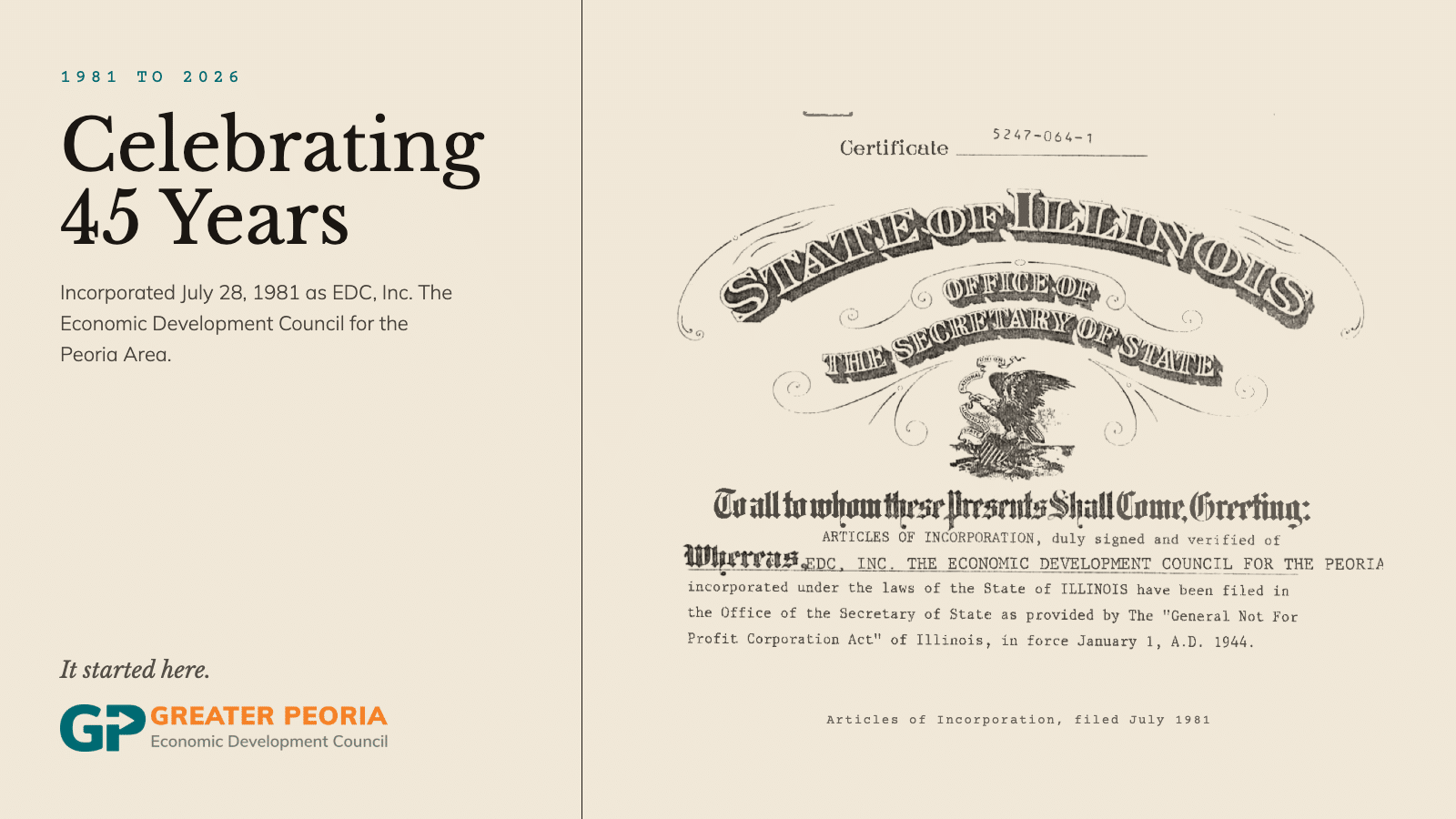
My friend and co-worker Sally Hanley stumbled upon a nugget of information while doing some paperwork recently: Our organization’s “Articles of Incorporation” were approved by the State of Illinois on July 31, 1981. That means that right around the time you are reading this article, Greater Peoria Economic Development Council is celebrating its 45th birthday. Now, in a community as old as ours, a tenure of 45 years does not put us in even the top hundred oldest organizations. But given that the entire profession of economic development is only 100 years old, we certainly are not rookies.
The Articles of Incorporation offer a glimpse into the organization’s early history. First, we had a pretty clunky name. At our founding, the organization was named “The EDC, Inc., The Economic Development Council for the Peoria Area.” What a mouthful! I hope they shortened that in some way, much like we often just refer to ourselves as “the EDC” when speaking locally. We actually still have to write that out on official documents like grant requests and banking information. In fact, that name was so long that it didn’t fit on the official Articles: the final “a” in “area” was left off.
Maybe more interesting were the names of the original Board of Directors. Do any of these names sound familiar?
- James Unland, James Unland & Company
- David Conner, Commercial National Bank
- Harry Feltenstein, Central Illinois Light Company
- Robert Gilmore, Caterpillar Tractor Co.
- Neil Tousley, Tousley-Iber Co.
- Richard Carver, Carver Lumber Company
- Robert Tieman, Pabst Brewing Company
- Philip Carlson, Peoria Area Chamber of Commerce
- Ralph Converse, IBM Corporation
- Daniel Gilbert, Eureka College
- Ed McGrath, St. Francis Hospital
Some of those names pop out, even to a non-native like myself. Dick Carver was mayor of Peoria when he was on our board, and just a few months before helping found the EDC, Mayor Carver presided over the ribbon-cutting of the just-completed Peoria Civic Center. Bob Gilmore was CEO of Caterpillar, and though he had quite an impact while leading the company, he has had a lasting impact on our community through the Gilmore Foundation. Daniel Gilbert led Eureka College from 1977 through the mid-1980s and I’m sure was pretty tickled to see his institution’s most famous alumnus actually become famous when he became President of the United States in 1981.
The early 80s were difficult in Central Illinois: Inflation was followed by soaring interest rates. A 1980 grain embargo against the USSR dropped exports by 20%. The resulting collapse in farmland property values led to bankruptcy for many, and difficulty in obtaining loans for others. This, in turn, made it hard for farmers to buy equipment from companies like Caterpillar, and combined with a global recession, Caterpillar laid off 17,500 by May of 1982. The founding of the EDC in 1982 was no coincidence; it was part of a plan to address what was happening.
Greater Peoria looks very different today than it did in 1982, and I wonder what our early organizational founders would think of where we are now. Manufacturing is still a cornerstone of our economy, but healthcare has become a dominant player. Forty-five years ago, would Ed McGrath of St. Francis Hospital have believed OSF would employ nearly 13,000 people in our region and be one of the state’s largest medical systems? Mayor Carver lived until 2023 and got a chance to see how his Civic Center played out, but would these men have contemplated the importance of the Peoria Riverfront Museum or the development in the Warehouse District? Could they have foreseen the boom in retail in East Peoria, sitting atop a former coal power plant and a former Caterpillar factory? Could they have imagined the suburban growth of places like Germantown Hills, Morton, Dunlap and Washington?
There are still issues in our economy, but there also is still an EDC to help address them. While the context may have changed, our mission remains the same: to drive investment and growth in Greater Peoria. Like the earliest version EDC, today’s organization is also led by a dedicated board of directors composed of a diverse set of business and civic leaders from across the region. Maybe in 2071 some future EDC leader will stumble upon some current artifact and recognize names like Songo Dede, Jennifer Zammuto, Henry Vicary, or any of our board leaders. Along with them, I am proud to help lead an organization that has worked so hard over a half-century to grow our region’s economy. Here’s to another 45!